
UX Designer vs UX Engineer: Which Career Should You Choose in 2026?
The world of UX is changing rapidly. Five years ago, becoming a UX Designer was one of the most sought-after career paths in technology. Today, companies are increasingly hiring UX Engineers, professionals who don't just design user experiences but also build them.
So, which career should you choose?
Should you focus on mastering user research, interaction design and usability? Or should you learn how to design and build interactive interfaces with code?
The answer depends on your interests, strengths, and career goals. In this guide, we'll break down the differences between UX Designers and UX Engineers, compare their skills, responsibilities, career opportunities, and explain how AI is reshaping both roles.
The Evolution of UX Careers
Traditionally, building a digital product looked like this:
Problem Identification → UX Design → Frontend Development → Backend Development → QA → Launch
Each team specialized in a different stage.
- The UX Designer focused on understanding users and creating intuitive experiences.
- The Frontend Developer translated those designs into code.
However, modern product teams are moving toward faster, more collaborative workflows.
Today, many companies follow a simplified process:
Problem Identification → UX Engineer → Backend Development → QA → Launch
By combining design and frontend implementation into a single role, organizations reduce handoffs, improve consistency, and accelerate product delivery. That shift is one of the main reasons UX Engineering has become one of the fastest-growing careers in product development.
What is a UX Designer?
A UX Designer focuses on creating products that are easy, enjoyable and meaningful to use. They research users, identify problems, design user flows, create wireframes, prototype interfaces and validate solutions through usability testing.
Their primary goal is to ensure that products solve real user problems.
A Typical Day
A UX Designer might spend time:
- Conducting user interviews
- Creating personas
- Mapping user journeys
- Designing wireframes
- Building prototypes
- Running usability tests
- Collaborating with Product Managers and Developers
They answer questions like:
- What problem are we solving?
- What do users actually need?
- Is this experience intuitive?
- How can we reduce friction?
What is a UX Engineer?
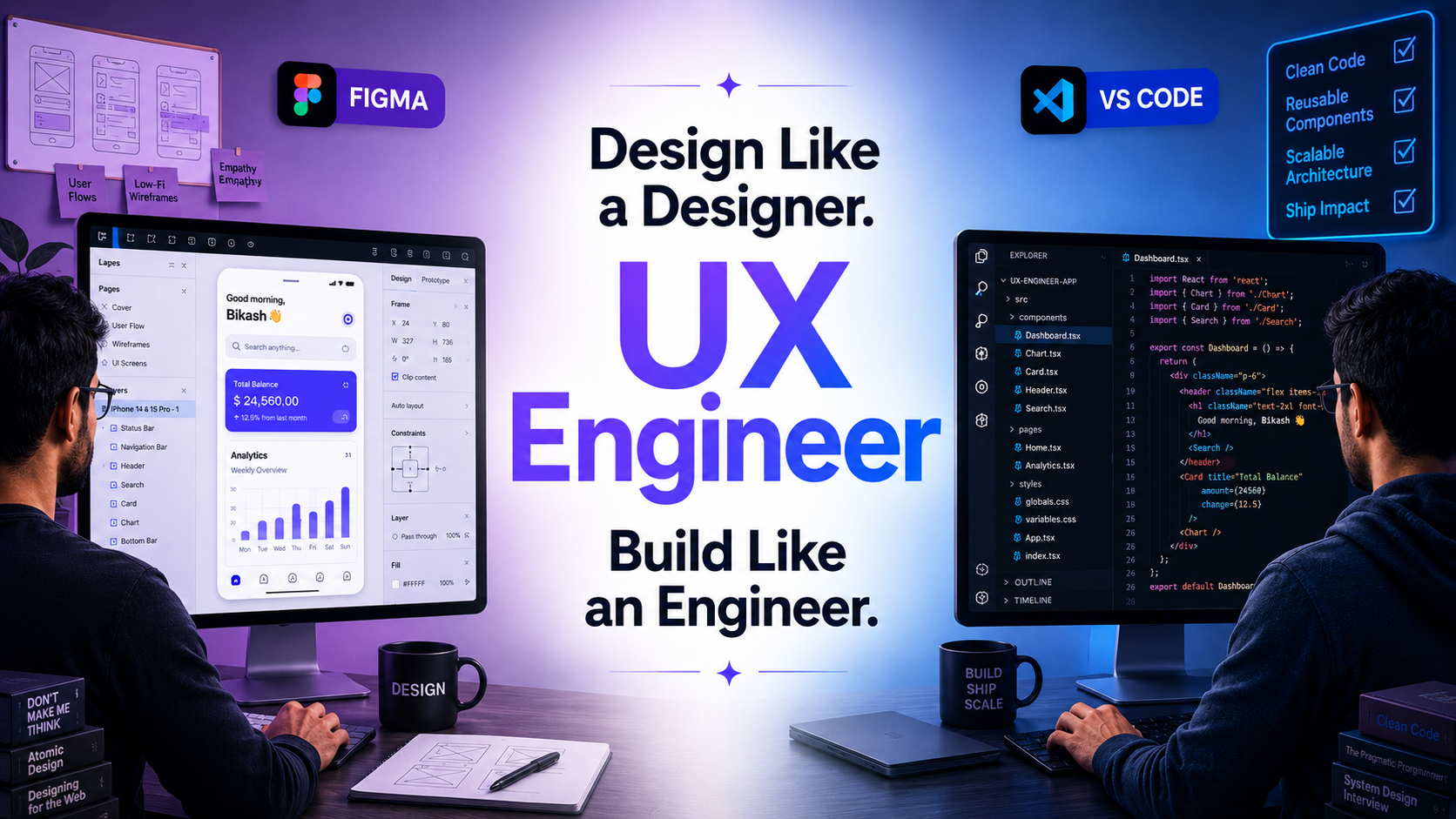
A UX Engineer combines UX Design with Frontend Development. They don't stop at designing interfaces, they build them. A UX Engineer understands user experience principles while also writing production-ready frontend code.
Instead of handing designs to another team, they bring those designs to life themselves.
A Typical Day
A UX Engineer may:
- Conduct UX research
- Design interfaces
- Create reusable components
- Develop responsive web interfaces
- Maintain design systems
- Improve accessibility
- Collaborate with backend engineers
They ask questions like:
- Can users complete this task easily?
- How can we build this efficiently?
- Will this component scale?
- Is the implementation accessible and performant?
UX Designer vs UX Engineer: Side-by-Side Comparison
| Category | UX Designer | UX Engineer |
|---|---|---|
| Primary Focus | User Experience | User Experience + Frontend Development |
| Research | ✅ | ✅ |
| Wireframing | ✅ | ✅ |
| UI Design | ✅ | ✅ |
| Prototyping | ✅ | ✅ |
| Frontend Coding | Basic | Advanced |
| HTML/CSS/JavaScript | Helpful | Essential |
| React | Optional | Recommended |
| Design Systems | Uses | Builds & Maintains |
| Collaboration | Designers & Developers | Product, Design & Engineering |
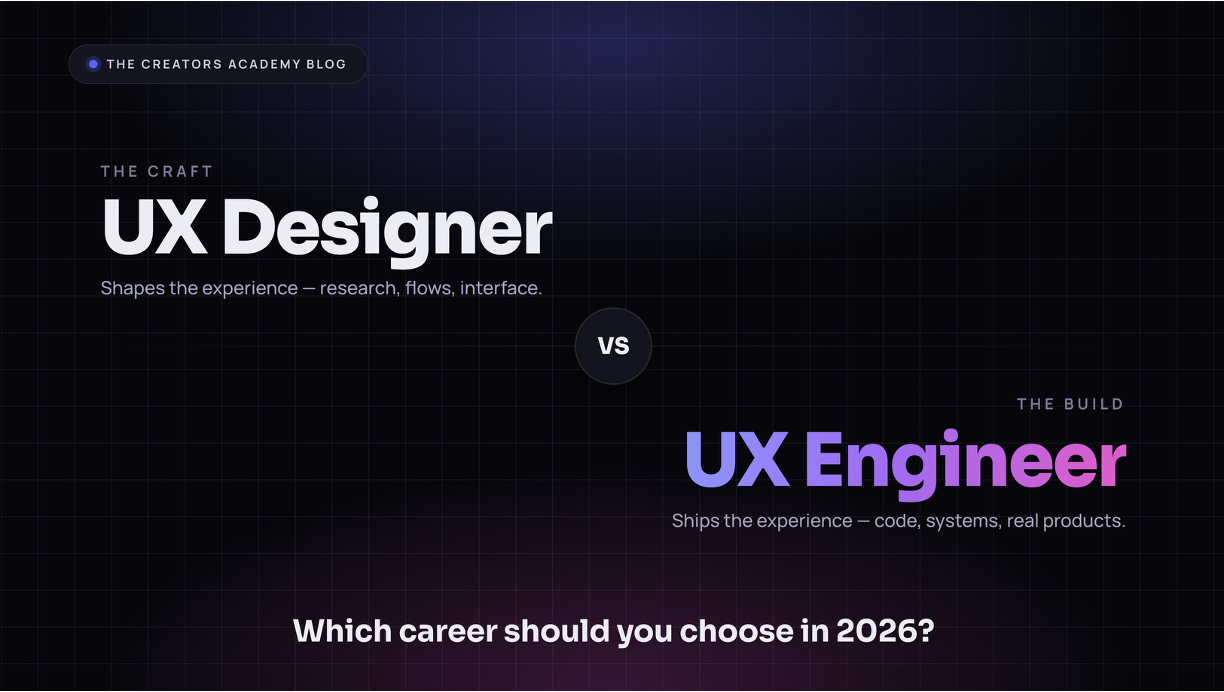
Both roles aim to create great user experiences. The difference lies in how much of the implementation they own.
Skills Comparison
UX Designer Skills
A successful UX Designer should master:
- User Research
- Information Architecture
- User Flows
- Wireframing
- Interaction Design
- Visual Design
- Usability Testing
- Accessibility
- Figma
- Design Thinking
UX Engineer Skills
A UX Engineer needs everything above, plus:
- HTML
- CSS
- JavaScript
- React
- APIs
- Responsive Design
- Component Libraries
- Git
- Design Systems
- AI-assisted Development
Think of a UX Engineer as a UX Designer with an engineering toolkit.
Which Role Pays More?
Compensation varies by country, company, and experience. However, UX Engineers often command higher salaries because they combine two specialized skill sets. Companies gain value from professionals who can:
- Reduce handoffs
- Speed up product delivery
- Improve design consistency
- Communicate effectively across teams
That said, salary should not be the only factor when choosing a career.
Choose the role that aligns with your interests and long-term goals.
How AI is Changing Both Careers
Artificial Intelligence is reshaping product development—but not in the way many people fear.
AI for UX Designers
AI helps automate:
- Research summaries
- Persona creation
- Wireframes
- UX Writing
- Design exploration
- Documentation
This gives designers more time to focus on strategy, creativity, and problem-solving.
AI for UX Engineers
AI assists with:
- Code generation
- Component creation
- Accessibility reviews
- Bug detection
- Documentation
- Refactoring
Instead of replacing engineers, AI accelerates development.
The Real Difference
Previously: UX Designer → Frontend Developer
Today: AI → UX Designer | AI → UX Engineer
Tomorrow: The professionals who know how to collaborate with AI will have the greatest advantage.
Which Career Should You Choose?
Choose UX Design if you:
- Love understanding people
- Enjoy research and strategy
- Prefer solving user problems
- Like creating user experiences
- Want to focus on product thinking
Choose UX Engineering if you:
- Enjoy both design and coding
- Love bringing interfaces to life
- Like building reusable systems
- Want faster career versatility
- Enjoy working closely with engineers
The Skills That Matter Most in 2026
Regardless of which path you choose, employers are looking for professionals who can:
- Solve real user problems
- Think critically
- Communicate effectively
- Work with AI
- Build modern digital products
- Collaborate across teams
- Learn continuously
Technology will evolve.
These skills will remain valuable.
Ready to Future-Proof Your Career?
The biggest mistake aspiring designers make is learning only the tools.
Tools change.
Principles don't.
At The Creators Academy, you'll learn:
- UX Fundamentals
- AI-first workflows
- Modern product thinking
- Industry tools
- Portfolio projects
- Mentorship from experienced professionals
Whether you become an AI-Driven UX Designer or a UX Engineer, you'll graduate with skills that employers actually need. Because companies don't hire people who know Figma. They hire people who know how to solve problems.